
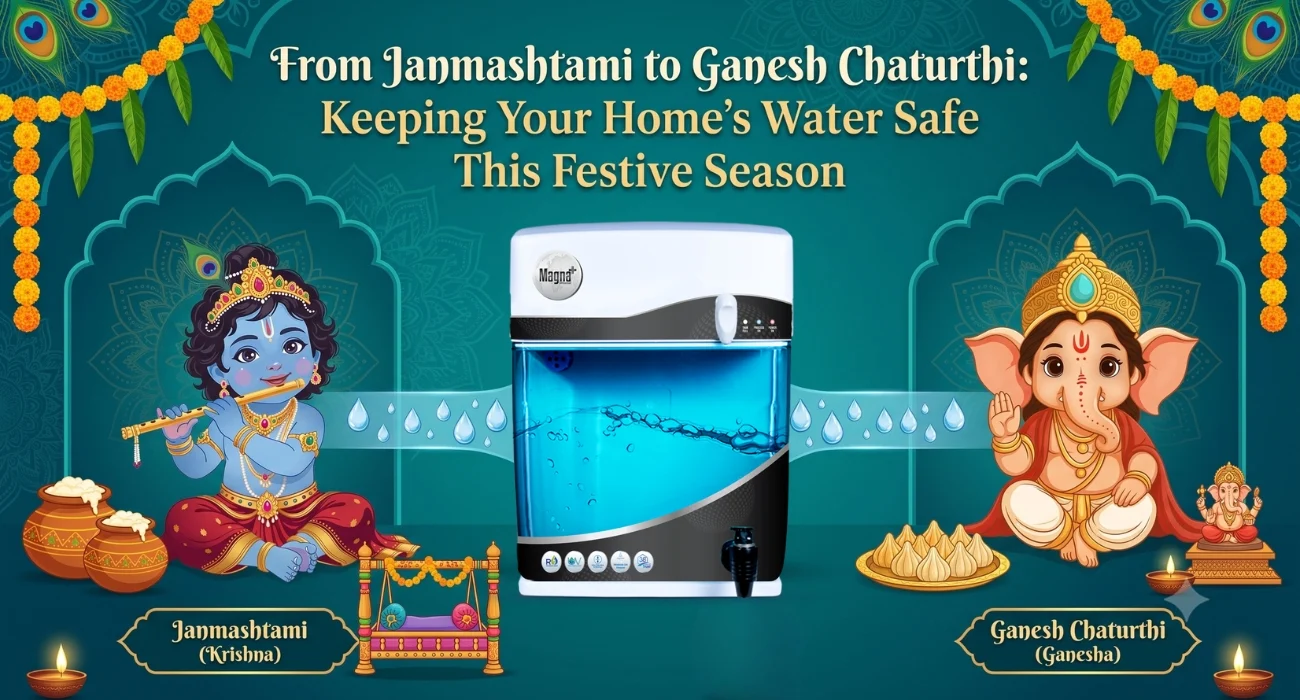
Between Krishna Janmashtami and Ganesh Chaturthi, most Indian homes quietly turn into a mix of kitchen, prayer room, and guest house, often all in the same week. Amid the modak-making, midnight aartis, and a steady stream of visitors dropping by for prasad and blessings, water safety at home is easy to push to the bottom of the to-do list. Yet festive season water safety matters more right now than almost any other stretch of the year, simply because more water is being used, by more people, more often, than your household is normally set up for.
A typical household’s water routine is built around a fairly predictable number of people and a fairly predictable set of tasks. Festivals throw both out of the window. Guests arrive without much notice, cooking runs longer than usual, and your purifier and storage tank end up working well past their normal daily load.
Janmashtami and Ganesh Chaturthi usually fall while the monsoon is still tapering off in most of India. Storage tanks are refilled more often to keep up with festival demand, sediment that’s settled over the season gets stirred up, and purifiers that were already working overtime through the rains are now handling an even bigger load. If your filters were due for a change, this is exactly the week that shortfall shows up.
If you’re hosting for Janmashtami midnight celebrations or a Ganesh Chaturthi visarjan gathering, a few checks before guests arrive save you from scrambling mid-celebration. Here’s how to prepare your home for festival guests without last-minute stress over your water supply:
The best water purifier for festive season hosting isn’t necessarily the most expensive one. It’s the one built for the specific strain a festival puts on your household: more people, more hot water for tea and prasad, and occasional power fluctuations from decorative lighting or a crowded circuit.
Look for these three things when you’re evaluating your setup ahead of the season:
ZeroB’s RO+UV purifiers are built for exactly this kind of mixed load, while the non-electric UF range keeps drinking water available even through a power cut. For homes hosting larger gatherings, Suraksha Tap 2.0 adds a simple, guest-friendly way to dispense purified water without anyone needing to touch the main unit.
It’s easy to think of water safety at home purely in terms of what goes into a glass, but the water that goes into your cooking matters just as much. Prasad is often shared with more people than a regular family meal, sometimes handed out to neighbours and visitors who drop by through the day, so the water used to prepare it deserves the same standard as your drinking water, not tap water straight from the source.
Not reliably. Tap water quality can dip during the monsoon-to-festival window due to storage tank turnover and treatment load, so it’s safer to use purified water for prasad and other food shared with guests, the same standard you’d use for drinking water.
Clean and cover your tank, check that your purifier’s filters aren’t overdue, run a quick TDS check, and set up a dedicated purified water point so guests have an obvious, safe source instead of an untested tap.
An RO+UV purifier with good storage or instant hot water works well for most homes hosting through Janmashtami and Ganesh Chaturthi. If power fluctuations are a concern during evening celebrations, pairing it with a non-electric purifier as backup keeps drinking water available regardless.
Yes. Filter life is one of the most common things people overlook before a festival. A quick service check a few days in advance means your purifier can handle the extra load instead of falling behind right when guests are over.
With an electric RO or UV purifier alone, no, water stops flowing until power returns. A non-electric UF purifier or a stored reserve of already-purified water solves this, which is why it’s worth having one on hand during a season known for power fluctuations.
Festive season water safety doesn’t need a complete overhaul of how your household runs, just a bit of preparation before the guests start arriving. A clean tank, a filter change, and a purifier that can keep up with the crowd are usually enough to keep the celebration about the celebration, not a scramble over drinking water. If you’re not sure your current setup is ready for the season, book a free water quality consultation with ZeroB, or explore our range of RO+UV and non-electric purifiers built for Indian homes and Indian festivals.
Explore ZeroB Products
WhatsApp us